> For the complete documentation index, see [llms.txt](https://docs.novaworks.net/spryx/llms.txt). Markdown versions of documentation pages are available by appending `.md` to page URLs; this page is available as [Markdown](https://docs.novaworks.net/spryx/woocommerce/product-filter.md).
# Product Filter
As of [WordPress 5.8](https://wordpress.org/news/2021/07/tatum/), the *Block Widgets Editor* replaces the previous widgets administration. The widget described here is available as a *Legacy Widget* when using the new *Block Widgets Editor*. However, to maintain full widget settings functionality, you must install the [Classic Widgets](https://wordpress.org/plugins/classic-widgets/) plugin which restores the previous (“classic”) WordPress widgets settings screens.
### Configuring Filter widgets
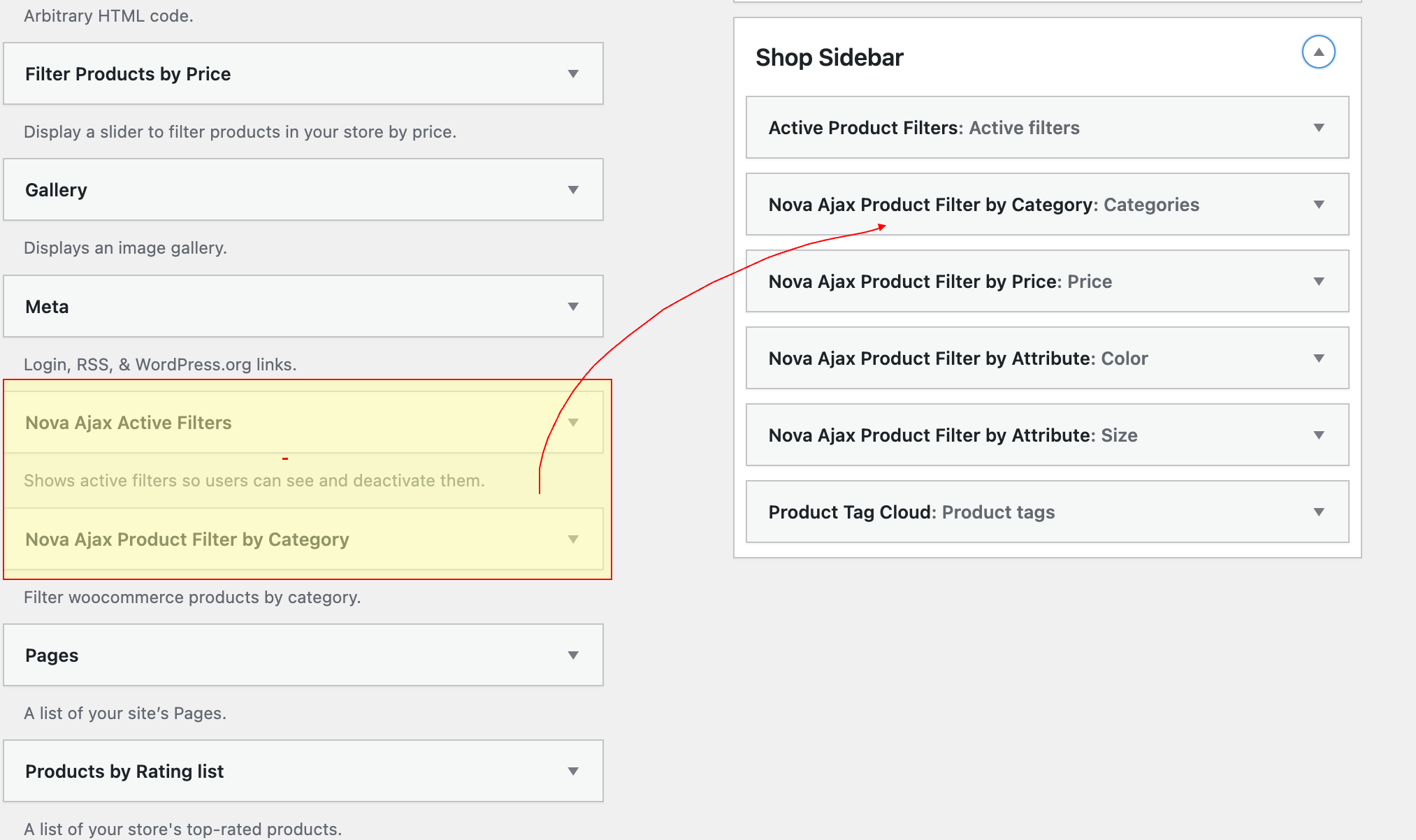
1. Click on **Appearance > Widgets** from the main navigation menu in your Dashboard.
2. Add new filter widgets from the Available Widgets section by dragging them to the Sidebar you want to customize.
3. Preview your site and you should see the content from your new Widget.
4. Return to the Widgets Screen to continue adding Widgets to the Sidebar as needed.
5. To arrange the Widgets within the Sidebar, **click, drag and drop** the widgets in the order you want.
6. To customize the Widget features, click the **down arrow** (or edit link) in the upper right corner to expand the Widget’s interface.
7. To save the Widget’s customization, click **Save**. (If simply moving a widget to the sidebar without making customizations, you do not need to click the Save button.)
8. Preview your site again, and all of your changes should be visible.
---
# Agent Instructions
This documentation is published with GitBook. GitBook is the documentation platform designed so that both humans and AI agents can read, navigate, and reason over technical content effectively. Learn more at gitbook.com.
## Querying This Documentation
If you need additional information that is not directly available in this page, you can query the documentation dynamically by asking a question.
Perform an HTTP GET request on the current page URL with the `ask` query parameter, and the optional `goal` query parameter:
```
GET https://docs.novaworks.net/spryx/woocommerce/product-filter.md?ask=&goal=
```
`ask` is the immediate question: it should be specific, self-contained, and written in natural language.
`goal` is optional and describes the broader end goal you are ultimately trying to accomplish on behalf of the user. GitBook uses it to tailor the answer towards what is most useful for that goal.
The response will contain a direct answer to the question and relevant excerpts and sources from the documentation.
Use this mechanism when the answer is not explicitly present in the current page, you need clarification or additional context, or you want to retrieve related documentation sections.